Easter 2026 Penalty Rates Calculator
Easter 2026 falls April 3-6. Calculate your exact penalty rate by award. Hospitality, retail, nursing and 40 more awards covered.
Senior Workplace Relations Writer · GradDip Employment Relations, Griffith University
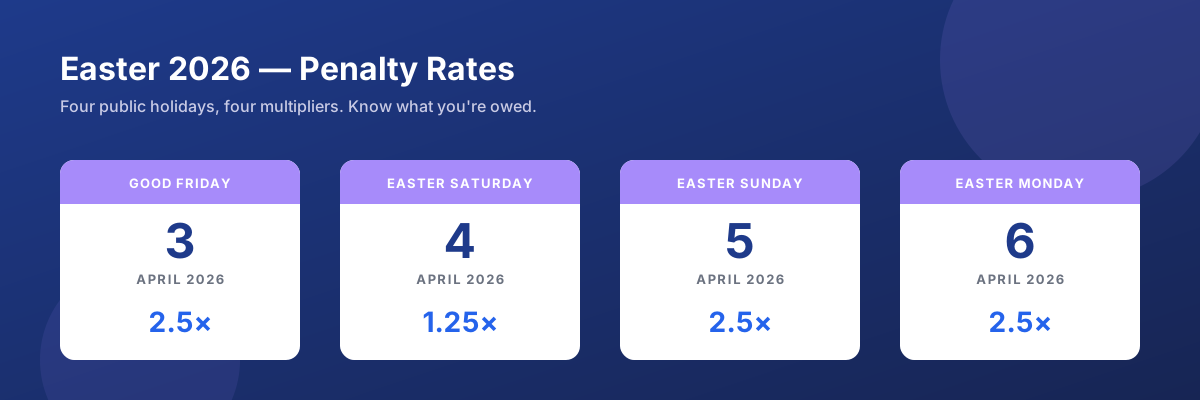
Easter 2026 dates and which days are public holidays
Easter 2026 falls on Friday 3 April to Monday 6 April. However, not every day in the Easter period is a public holiday in every state and territory, and this directly affects whether you're entitled to penalty rates. Good Friday (Friday 3 April) is a public holiday in all states and territories — no exceptions.
Easter Saturday (Saturday 4 April) is a public holiday in every state and territory except Tasmania and Western Australia. In those two states, Easter Saturday is a normal Saturday, and standard Saturday penalty rates apply rather than public holiday rates.
Easter Sunday (Sunday 5 April) is a public holiday in every state and territory except Tasmania — that is the ACT, New South Wales, the Northern Territory, Queensland, South Australia, Victoria and Western Australia. In Tasmania it is an ordinary Sunday, and you receive the normal Sunday penalty rate from your award rather than the higher public holiday rate.
Easter Monday (Monday 6 April) is a public holiday in all states and territories.
In practice, this means workers in the ACT, NSW, NT, QLD, SA and VIC get four consecutive public holidays — Good Friday, Easter Saturday, Easter Sunday and Easter Monday.
Western Australia gets three: Good Friday, Easter Sunday and Easter Monday, with no Easter Saturday. Tasmania gets two — Good Friday and Easter Monday — and separately observes Easter Tuesday, which Fair Work notes is generally for the Tasmanian Public Service only, so most private sector Tasmanian workers are not entitled to public holiday rates on that day.
Know your state, check your roster, and make sure your pay reflects the correct rate for each day (and yes, this applies to casuals too).
Public holiday penalty rates by award
Penalty rates on public holidays are set by your award or enterprise agreement. For the most common awards covering Easter workers, here are the public holiday rates. Under the General Retail Industry Award 2020, full-time and part-time employees earn 225% of their ordinary hourly rate for hours worked on a public holiday.
Casual employees earn 250% of their ordinary hourly rate (this is inclusive of the casual loading — casuals don't get 250% plus casual loading on top). Under the Hospitality Industry (General) Award 2020, full-time and part-time employees earn 225% of their base rate, and casuals earn 250%.
Under the Fast Food Industry Award 2020, the same structure applies — 225% for permanent employees and 250% for casuals on public holidays. Under the Clerks — Private Sector Award 2020, full-time and part-time employees earn 250% on public holidays, and casuals earn 275%. Under the Health Professionals and Support Services Award 2020, full-time and part-time workers receive 250%, casuals receive 275%. If your workplace has an enterprise agreement, check whether it specifies different rates — but under the better off overall test (BOOT), your agreement cannot leave you worse off than the relevant award.
Worked examples: what you actually earn per hour on Easter public holidays
Let us run the numbers so you know exactly what to expect on your payslip. If your ordinary base rate is $25.00 per hour and you're a full-time or part-time employee under the Retail, Hospitality, or Fast Food awards, your public holiday rate at 225% is $56.25 per hour. For an 8-hour shift on Good Friday, you earn $450.00 before tax — compared to $200.00 on a normal weekday.
The short answer? If you're a casual under those same awards at 250%, your hourly rate on a public holiday is $62.50, meaning an 8-hour shift pays $500.00 before tax. For a higher base rate of $30.00 per hour, the numbers are: $67.50 per hour at 225% ($540.00 per 8-hour shift) or $75.00 per hour at 250% ($600.00 per 8-hour shift).
For a base rate of $35.00 per hour: $78.75 at 225% ($630.00 per shift) or $87.50 at 250% ($700.00 per shift). If you work all four Easter public holiday days (in NSW, ACT, or QLD where all four days qualify), a full-time retail worker on $25/hr earns $1,800.00 before tax across four 8-hour shifts — compared to $800.00 for four normal weekday shifts. That is an extra $1,000 in one long weekend. Part-time employees working fewer hours still receive the same multiplied rate for every hour worked.
What if Easter Saturday or Sunday isn't a public holiday in your state?
If Easter Saturday is not a public holiday in your state (Tasmania and Western Australia), you receive standard Saturday penalty rates under your award. For the Retail Award, Saturday rates are 125% for full-time and part-time employees, and the ordinary casual rate with loading (usually around 150% of base). For the Hospitality Award, Saturday ordinary hours attract a loading: 125% for full-time and part-time employees and 150% for casuals.
Similarly, if Easter Sunday is not a public holiday in your state — which in 2026 means Tasmania only — Sunday penalty rates apply instead of public holiday rates. Under the Retail Award, Sunday rates are 150% for full-time and part-time employees (reduced from the previous 200% following penalty rate reforms).
For the Hospitality Award, full-time and part-time employees receive 150% on Sundays, and casuals receive 175%. The difference between Sunday rates and public holiday rates is significant — at $25/hr base rate under the Retail Award, Sunday pays $37.50 versus the public holiday rate of $56.25. That is $18.75 per hour less, or $150 less over an 8-hour shift, just because of which state you work in.
Can you refuse to work on Easter public holidays?
Under the National Employment Standards (NES) in the Fair Work Act 2009, an employee can refuse a request to work on a public holiday if the refusal is reasonable, or if the request itself is unreasonable. The Act does not define a blanket right to refuse — it requires a balancing test. Factors considered in determining reasonableness include the nature of the workplace (a hospital has a stronger case than a retail store), the employee's personal circumstances (family or religious commitments, caring responsibilities), whether the employee was given reasonable notice, whether the employee is entitled to penalty rates or other compensation, the employee's usual working pattern, and whether other employees are available to work.
If you're a casual employee, your right to refuse is generally stronger because you've no guaranteed hours. If you're full-time and your contract or roster regularly includes weekend work, refusing may be harder to justify.
Your employer must make the request — they can't simply roster you on a public holiday without asking. If you believe you have been unreasonably required to work, or if you have been penalised for reasonably refusing, this may constitute a breach of the NES and you can contact the Fair Work Ombudsman for assistance.
Substitute public holidays and Easter Tuesday in Tasmania
Some employers and employees may agree to substitute a public holiday for another day. Under section 115 of the Fair Work Act, an employer and employee (or an employer and a majority of employees) can agree to substitute a different day for a public holiday. If a substitution is agreed, the substitute day becomes the public holiday for penalty rate purposes, and the original day is treated as an ordinary working day.
This is most commonly used when a business needs to operate on the actual public holiday but wants to give employees a day off at another time. The substitution must be a genuine agreement — an employer can't unilaterally declare a substitute day.
Additionally, Tasmania is the only state that observes Easter Tuesday. Fair Work lists Tuesday 7 April as a public holiday generally for the Tasmanian Public Service only, so it is not a general entitlement — most private sector workers in Tasmania should not expect public holiday penalty rates on that day. Tasmania is also the only jurisdiction where Easter Sunday is not a public holiday, so a Tasmanian private sector worker generally has two Easter public holidays, Good Friday and Easter Monday, against four in the ACT, NSW, NT, QLD, SA and VIC and three in WA. Check your state government's gazette for the official list of public holidays to confirm exactly which days apply to you.
How to check your Easter pay is correct
After the Easter long weekend, verify your payslip carefully.
After the Easter long weekend, verify your payslip carefully.
Quick version:
- identify which days in the Easter period are public holidays in your state using the breakdown above
- check that each public holiday shift is paid at the correct penalty rate under your award — 225% or 250% for most retail and hospitality workers
- check that any non-public-holiday days (like Easter Saturday in WA/TAS or Easter Sunday in VIC/SA/WA/TAS/NT) are paid at the correct Saturday or Sunday penalty rate, not the lower weekday rate
- if you didn't work on a public holiday that fell on a day you would normally work, check that you were paid for the day at your ordinary rate — full-time and part-time employees are entitled to be absent on a public holiday and still receive their base pay for their ordinary hours
If your pay is incorrect, raise it with your employer first, referencing the specific award clause. If the issue is not resolved, the Fair Work Ombudsman provides a free Pay and Conditions Tool (PACT) where you can look up the exact rate you should have been paid.
You can also call the Fair Work Infoline on 13 13 94 for assistance, or lodge a formal dispute.
Keep copies of your roster and payslips as evidence.
FairWork Mate AI
Have a question this article didn't cover?
Cited answers grounded in the Fair Work Act, your award and the Fair Work Commission decisions behind them. Free to start.
Ask the advisor →Pro is $29.99/mo for 150 questions, or a $4.99 Day Pass covers 25 questions for 24 hours. See plans
Get pay and rights updates for your job
Free email updates when award rates, the minimum wage or workplace laws change.
Free forever. No spam. Unsubscribe anytime.
Official resources
General information and estimates only — not legal, financial or tax advice. Always check your specific award, agreement or contract, or a qualified professional, before you rely on the result.
Related articles
Easter Sat earned you 225% (full-time) or 250% (casual). Good Friday and Monday are public holidays. Here's how to check your payslip and recover underpayment.
Superannuation Guarantee Rate 2026-27: 12% (Unchanged) + Payday Super RulesThe super guarantee rate is 12% for 2026-27 (unchanged since 1 July 2025). From 1 July 2026, super must reach your fund within 7 business days of payday.
Minimum Wage History Australia: 2025 vs 2026 Comparison & Annual IncreasesTrack Australia's minimum wage increases from 2024 to 2026. Compare $23.23/hr (2024) to $24.95/hr (2025) to $26.44/hr from July 2026. Percentage increases, FWC annual review timeline, and how award rates change.
Penalty Rates Australia 2026: Saturday, Sunday & Public Holiday PayYour weekend and public holiday penalty rates by award — retail, hospitality, fast food & more. Free calculator shows exactly what you should earn per hour.
Nine years in Australian workplace relations — Queensland hospitality HR, then retail ER in Brisbane and Northern NSW. Graduate Diploma in Employment Relations (Griffith University, 2018). Writes about award interpretation, underpayment recovery, and casual conversion. Member of the AHRI since 2019. Based in Paddington, Brisbane.